
| Next | Previous | Index | Tellout Home |
12. Episcopal Church Lompoc
Coveted Gothic Jewel
 Being an evangelist has its blessings, but it also has its drawbacks. Captain Ray's work at Camarillo, a thriving community of 66,000 in Ventura County, had been so enjoyable that he did not want to move when the time eventually came. The bishop had asked him to go down to the Lompoc Episcopal Church, but he wrote back begging for six months' grace. The bishop's stern reply left everyone in no doubt, "Your move," it read, "is an accomplished fact - facti accompli!"✞
Stained Glass
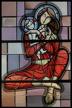 As I left Highway 101 for the Lompoc turnoff, an eerie silence seemed to descend. Deep green moss draped the shaded oak trees on both sides. A night fog lay like a sinister carpet upon the fields. Except for the purring of my engine, all was hauntingly quiet and still. The tall stacks of a mine glinted in the dusk sun on my left. Then, in a halo of mist, St. Mary's beautiful timbered Episcopal church suddenly rose, a coveted Gothic jewel lovingly built in the center of town. The derelict and broken down Parish House next to it stood out in stark contrast. To my surprise, the church was ablaze with light. A crowd of people milled around the doorway outside. "Are they the members of some neighboring congregation?" I wondered. "Who had come out to welcome me?"✞
Lutheran Congregation
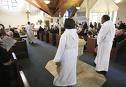
 A dynamic Lutheran congregation was worshipping in St Mary's Episcopal Church Lompoc while the Episcopalians stood outside in the rain. I strutted across to St Mary's, expecting to be greeted by the congregation. As I approached, however, it became increasingly clear that they were not interested in me. I headed instead toward a clergyman on one side of the group. "Our Lutheran congregation," he told me proudly, "use this building four nights a week and every Sunday for our services and Sunday School." Annoyance swelled up inside, and as courteously as I could manage, I probed further, "When do the Episcopalians meet then?" "Them," he replied, a smile spreading across his face, "there aren't many of those in town. They don't use this building much, except their service after ours have finished!"✞
A New Start
 That first dull, foggy Sunday at St Mary's, a group of us waited in the rain outside the church. The Lutheran congregation had nurtured a strong and growing fellowship in the same building where our church was dying. I was shocked that our people had agreed to rent the Church building for only forty dollars a month to help pay their expenses. "I'll write to the bishop about this in the morning!" I vowed quietly to myself. The bishop agreed, the Lutherans moved, and we began repairs on the church and Parish house.✞
Wallpaper Sample Books
 Tearing off the wallpaper was how we raised funds for our new St Mary's Vicarage in Lompoc. Only a few weeks after beginning at the church, tragedy struck. Loud cries summoned me from my bed in the middle of the night. "The Vicarage is on fire!" A group of us stood by helplessly watching the hungry flames consume the dry timber building. In the amber glow against the black of the night, I picked out a friend's features. "It's not that bad," I said hopefully, "it's only something material." Awakened, the Church Warden, who happened to be standing directly behind me, replied caustically, "It's only material, but it took us twenty years and endless labors to pay for it!" Soon afterward, plans began to build to emerge for a new Vicarage there. To help this effort, the parish committee decided, in its wisdom, to appoint a professional fundraising director. It was then that my troubles began! Our youthful new director was full of bright ideas! One of his first was finding old wallpaper sample books and roughly tearing out the leaves. Then as we handed these to our astonished neighbors, we said, "We're tearing off the wallpaper to invite you to our church family dinner in support of the new vicarage!"✞
Lompoc Church Dinner
 Annie King of Kilkenny Ireland unexpectedly funds the Episcopal Lompoc Church dinner after a feud over a meal. We intended this Lompoc Church dinner for St. Mary's Vicarage to be one of those grand occasions with all the trimmings. "The Episcopal Church Lompoc dinner will be free for everyone," insisted the fundraiser. " church funds will bear the cost!" Our ladies, however, stubbornly refused to sit by. They wanted to do all the cooking themselves, but the fundraiser was adamant, "the church must pay for a caterer to make the Church Dinner." Deadlock! That following Sunday, a hushed congregation listened intently for the announcement about the dinner. "The grand Church dinner," I proclaimed, "will be held next week through the kind donation of a certain Annie King of Kilkenny, Ireland. We will invite everyone, and it is free! We will not use church funds!" After the service, the church buzzed. "Who is this, Annie King?" everyone was asking. "Why is she paying the bill?" The sponsor of the Church dinner was a closely guarded secret. Only I and two others knew that this was my late mother, Annie King-Lewis, who had once lived in Southern Ireland. Donating this amount in her memory blessed our parish and restored harmony. Annie King's dinner aside, rumor had it that the government was about to announce plans to build a missile site in Lompoc, bringing much-needed employment to the area.✞
Lompoc Church Revival
 A Lompoc Church revival comes to town with the announcement of a new airbase for rocket firing at Vandenberg. A few days before Christmas, a clue appeared in the Lompoc Herald indicating a new plant was coming. A cartoon showed a jolly Santa Claus riding a gleaming missile toward the town with the greeting, "Merry Christmas to Lompoc." Later, the official announcement came that they would build the Vandenberg Base there. New life and a Church revival were on their way! Optimism permeated the whole church now. As if to herald the government's decision, the bishop announced that he would soon appoint a clergyman to the parish. I would go to see Dean Drake about my next assignment.✞
Colton Revival
After talking about the San Bernardino area for some time, Dean Drake mentioned how concerned he was for our little church in Colton, California. "Captain," he announced very soberly, "I want you to go there, ignite the fuse, and start a revival!" A puzzled look crept across my face. He added, "You can do anything you wish! I am giving you a blank check! You can lead the revival any way the Holy Spirit leads you!"✞
"Episcopal Church Lompoc"
by Ron Meacock © 2021
| ^Top Page | Next | Previous |