Brothers :
The Holy Spirit
and Jesus
| Next | Previous | Index | Tellout Home |
2. Holy Trinity Persons
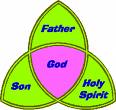 The concept of three persons in the Godhead permeates the Scriptures from Genesis to Revelation. But the actual word "Trinity" from the Latin word "Trinitas" or "Trinus" does not appear in the Bible! Theophilus of Antioch (c110-c184 AD) was the first to use the Greek word "Trinity" in c170 AD. However, he did not use the standard formula of "Father, Son, and Holy Spirit" to describe the Trinity. Instead, Theophilus stated it as "God, his Word (Logos) and His Wisdom." ✞
Christian
Theophilus was educated in the Greek tradition and became a Christian as an adult after extended deliberation, and by 170 AD was elected Bishop of Antioch. He explained the meaning of the term "Christian" to his contemporaries. "About your laughing at me and calling me Christian, you know not what you are saying because that which God anoints is sweet and serviceable and far from contemptible." I believe that "anoints" to Theophilus meant receiving the Holy Spirit. ✞
Triad
An alternative Greek word used for "Trinity" is "triad, treis or tria," or from the Latin "tres and tria," all of which mean "a set of three" or "the number three." From this root "tri," we get other English words like a camera tripod with three legs, a triangle with three sides, and then the more obscure words like "triptych" meaning something with three folds or panels, and "trammel" being a fishing net or mesh made out of three layers, a trimaran sailboat with three hulls, and in chemistry as a triacid or triatomic base having three atoms in a molecule. The capital and largest city in Libya of three million people is called "Tripoli," a Greek name meaning "Three Cities." ✞
Inspiration of the Word
Theophilus writes about the word Trinity, "In like manner also the three days before the luminaries, are Trinity types of God, and His Word, and His wisdom." Theophilus also penned a letter, "to Autolycus," who was a pagan friend "The holy writings teach us, and all the spirit-bearing men, one of whom, John, says, 'In the beginning was the Word, and the Word was with God,' showing that at first God was alone, and the Word in Him." Although Theophilus depended upon the Old Testament, he was the first writer who explicitly stated the inspiration of the New Testament. He said that the evangelists were divinely inspired, on a par with the Prophets adding that the Gospels were a holy word, and the Pauline Epistles, a divine word. ✞
Trinitarianism
'Trinitarianism' describes belief in the three persons of God in one. It contrasts with other faith systems such as 'Binitarianism,' which means one deity in two persons or two deities. Then there is 'Monarchianism' with no plurality of persons within the Godhead. Monarchianism emphasized God as one indivisible being. Monarchianism developed in the second century and persisted into the third century. It was generally considered a heresy after the fourth century AD. ✞
Holy Essence
The Father, Son, and Holy Spirit have different qualities and personalities but still have the same holy essence. In Hebrew, the "Holy Spirit" is called the "Spirit of Yahweh." This word comes from the Hebrew word "ruach," meaning "holiness spirit" or "holy place spirit." The Trinity contains three distinct persons in one deity. ✞
Three Deity Roles
 The descriptive word "persons" in the Godhead depicts each personality's role in their relationship. The "Trinity" defines three separate and quite distinctive ways the Holy Trinity functions. An excellent example of this occurs in 1 Peter 1.1-2 where Saint Peter wrote, "Peter, Jesus Christ's apostle, to God's elect, who have been chosen according to God the Father's foreknowledge, through the Spirit's sanctifying work, in obedience to Jesus Christ and sprinkled with his blood." Here we have from Saint Peter a specific Trinity reference to Father, Son, and Holy Spirit. ✞
Mother Daughter Wife
We may also view the persons of the Holy Trinity as family members. A man can be a father, son, and husband at the same time. Also, a woman may be a mother, daughter, and wife at one time. Godhead individuals can equally be the Heavenly Father, the only begotten Son, and the Holy Spirit with different roles simultaneously but still be of one essence or family. ✞
Primary Colors
 God is always more significant than the total of the three Trinity persons. Consider how nature contains the three primary colors of red, blue, and yellow. These primary colors mixed in different proportions make up a rainbow of other colors, including orange, purple, and green. All the colors emanate from the three primary ones, so that orange is yellow plus red, purple is blue plus red, and so on. The complex nature of the persons of the Holy Trinity parallels this. Pure white light splits in a prism to form the rainbow colors of red, orange, yellow, green, blue, indigo, and violet. All the spectrum colors combine to create pure white light, like the three members of the Trinity who come together as one God. Separately, they form a whole range of other colors. ✞
White Paint
From whiteness come all the rainbow colors. Interestingly, the inventor claimed to be the whitest paint in the world has been created in a lab at Purdue University in the United States by Xiulin Ruan, a professor of mechanical engineering. It is so white that it could eventually reduce or even eliminate the need for air conditioning. The paint reflects 98.1% of solar radiation while also emitting infrared heat. It absorbs less heat from the sun than it sheds, and a surface coated with this paint is cooled below the surrounding temperature without consuming power! The paint has been included in the Guinness World Records Book as the whitest ever made! ✞
Creation Roles
 The Creation story contains all three of the Holy Trinity persons. Saint John explains the role of Jesus at the Creation in John 1.1-2, "In the beginning was the Word, and the Word was with God, and the Word was God. He was with God in the beginning." The Living Bible helpfully adds in John 1.3, "He created everything there is, nothing exists that he didn't make." As the Word (or the Logos), Jesus is at the very beginning of all things. As God, he is eternal and has no beginning or end, and he was present even before the time of the Creation. God's Word causes matter to come into existence. ✞
The Word
The NIV Commentary explains the phrase "word," "The Greeks used the phrase 'Word' not only of the spoken word but also of the 'unspoken word.' The unspoken word is still in mind as the reason." Jewish scholars, however, utilized the phrase "Word" as a way of referring to God. Therefore, the Apostle John cleverly employed a term familiar to both Jewish people and Greeks. Romans 9.5 asserts that Jesus is God in a total sense, "Their's (the people of Israel) are the patriarchs who trace the Messiah's human ancestry from them, who is God over all, forever praised! Amen." The NIV offers an alternative translation as "the Messiah God, who is over all, forever praised!" The Messiah Jesus is God overall as a Holy Trinity person! ✞
The Universe
In the word "Universe," the Greeks meant the rational principle that governed all things. It has, however, come to mean "all of space, time and their contents, including planets, stars, galaxies, and all other forms of matter and energy," according to Wikipedia. The Big Bang Theory is the prevailing cosmological description of the development of the universe. By this theory, space and time emerged 13.799 billion years ago. The observable universe is "93 billion light-years in diameter approximately at this present time" as it expands, or so it is thought by the scientists. "The Hubble Ultra-Deep Field Telescope image shows some of the most remote galaxies visible with present technology, each of billions of stars." The Bible teaches that the Father, the Son, and the Holy Spirit were present to oversee the Creation at the beginning! ✞
Jesus Pre-existence
 Jesus existed and was loved before God created the universe. In John 17.24, Jesus says, "Father, I want those you have given me to be with me where I am and to see the glory you have given me because you loved me before the world's creation." The Expositor's Study Bible comments, "Jesus proclaimed his pre-existence with the Father and therefore his deity." Note this last phrase where Jesus claimed to be loved and existed and was present before the Creation! The Holy Spirit hovered over the waters, and Jesus, according to the Epistles, stood in the background. ✞
Chosen
The Father loved Jesus, who was present before the Creation as one of the Holy Trinity members! Saint Paul later wrote of Jesus in Ephesians 1.4, "Praise be to the God and Father of our Lord Jesus Christ, who has blessed us in the heavenly realms with every spiritual blessing in Christ. For he (Jesus) chose us in him before the world's Creation to be holy and blameless in his sight." Jesus picked out his apostles and disciples before the Universe's Creation! He chose you and me as his disciples before the foundation of the world! An astonishing truth to contemplate! ✞
"Holy Trinity Persons"
by Ron Meacock © 2021
| ^Top Page | Next | Previous |