
| Next | Previous | Index | Tellout Home |
19. Priscilla and Aquila
Wealthy Business People
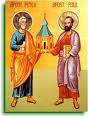 Though Saint Luke the Evangelist's description is not completely clear, it would seem probable that Apollos does not know of the risen Lord until Aquila and Priscilla, who are two wealthy businesspeople, inform him. He is merely impressed with John the Baptist, who foretells the coming of one mightier than himself, the Lord Jesus Christ. Dr. Michael Green, the British author and evangelist (1930-present), tells us that Priscilla and Aquila are wealthy and generous people who own homes in several cities. They are prepared to take lodgers like Saint Paul and Saint Apollos, and they are willing to open their homes up further to the Christian community with all the inconvenience that sometimes involves. Households of Faith most probably meet in Priscilla and Aquila's homes in Corinth, Ephesus, and Rome. They keep open house and go to the trouble of writing commendatory letters for their visitors upon departure, putting them in touch with other Christian friends elsewhere. They do not forget absent friends either but are diligent in sending greetings to them. ✞
Infectious Faith
There must be something infectious about their Christian faith and their relationship to one another, impressing visitors to their homes. Apollos learns "the Way" or what it means to be a follower of Christ from his stay in Priscilla and Aquila's house. "The Way" is probably an early derogatory description of the Christian community and its disciples. "The Way" was initially considered as a sect. Their name probably comes from a saying of Jesus in John 14.6, "I am the way, the truth, and the life, no man comes to the Father, but by me." Acts 24.14 also describes the Christian church as "The Way" when Saint Paul says, "I admit that I worship the God of our ancestors as a follower of the Way, which they call a sect." "The Way" incidentally is also a description of the later pilgrimage route called "the Way of St James" from France into Spain. Although Apollos is already an expositor of Scripture, we read that he learns to show from the Scriptures that Jesus is the Messiah. ✞
Encouragement
 The Priscilla and Aquila households welcome Saint Paul and encourage him in the Christian Faith. When Paul meets Priscilla and Aquila, he appears somewhat depressed after his comparative lack of success in Athens. Dr. Michael Green explains, "Companionship in their household revived him. He began to argue in the synagogue weekly and convince both Jews and Greeks about the truth of Jesus." Moreover, we read that he becomes gripped by the Word while staying at Priscilla and Aquila's home. Is this a result of the daily family study of the Scriptures in which they engaged? Though much is guesswork as we try to look at these early Christians' lives, it is clear enough that they had a warmth of faith in Jesus Christ and love for him. This faith leads them to sacrifice privacy, security, finances, and even personal safety (on one occasion, they risked their lives for Paul) to spread the gospel. Priscilla and Aquila's homes must have been exceedingly useful in the church's evangelistic outreach and a beautiful Christian model to follow today. ✞
Early Christian House
 Another Early Church house becomes a center in which people like Justin Martyr convert to the faith. The conversion of an Early Christian House is the natural or even the necessary way of establishing a new religion in unfamiliar surroundings. Still, early Christian houses remain the soundest basis for the meetings of Christians. In several cases, the preachers are entertained and requested to carry on their activities from that platform. In one letter, where they send greetings, three groups of people represent early Christian houses, and two others are from other household members. Their heads are, by implication, not Christians. This latter phenomenon suggests a looseness in the groups concerned, though it is still significant that even when detached from their group for religious reasons, they remain a coherent body. ✞
Faith House
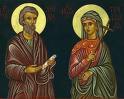 A Christian faith house such as Priscilla and Aquila's, where they pray daily, becomes the center of Christian ministry operations in an area. Saint Paul uses Christian faith houses to offer hospitality and teach the Scriptures. He shows his loyalty to Israel's hope and his deep conviction that salvation lies in Jesus. Dr. Michael Green adds, "when Paul claimed in his farewell address to the Ephesian elders that he had taught them, in public and from house to house, testifying both to Jews and Greeks of repentance to God and faith in our Lord Jesus Christ, it was no idle boast. One Christian faith house belongs to a first-century couple, Aquila and Priscilla. Whether or not they are Christians before they meet Paul at Corinth is disputed, but there can be no doubt about it. It is, obviously enough, one of several worshiping Christian faith houses." As Jews, Priscilla and Aquila would have prayed daily in their home together. As Christians, they would have done no less. They are probably regular attendees at the synagogue, and it is here that they discover Apollos. Seeing that they can be of help to this most promising and talented person, they invite him round to their home and instruct him further in the faith." ✞
Gospel House
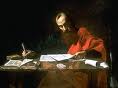 Many a Roman Christian house becomes a center of faith where believers gather and evangelize the city. There are various ways of using Christian homes in the service of the gospel. The Acts of the Apostles shows us many Christian gospel houses being used for prayer meetings, for an evening of Christian fellowship, for Holy Communion services, for a whole night of prayer, worship, and instruction. They are also developed for impromptu evangelistic gatherings and for planned meetings to hear the Christian Gospel, following up inquiries, and organize education. ✞
Center of Evangelism
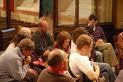 In Rome, we find Saint Paul making the most exciting use of his hired house. Dr. Michael Green explains, "He [Paul] was no longer able to go out to preach the gospel, so he invited leading Jews to come to his residence for a full day of talking and discussion. His approach is superb. He takes the initiative and explains why he is in Rome before they could produce any garbled accounts that may have reached them from Judea. He was brief, factual, friendly, and to the point." Like that of Priscilla and Aquila, the Christian Gospel house is an effective means of doing evangelism. "What uses did early Christians make of their houses? Which of these methods could be useful today?" ✞
"Priscilla and Aquila"
by Ron Meacock © 2021
| ^Top Page | Next | Previous |