
| Next | Previous | Index | Tellout Home |
18. Acts Christian Home
House Church Movement
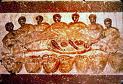 Spreading the gospel in antiquity is primarily based on the use of Christian homes. We encounter Jesus speaking to the people as he sits in friend's houses with them. Luke 7.36 relates, "When one of the Pharisees invited Jesus to have dinner with him, he went to the Pharisee’s house and reclined at the table." The comparatively small numbers involved have definite advantages and make real interchange of views and informed discussion among the participants possible. There is no artificial isolation of a preacher from his hearers. There is no temptation for either the speaker or the heckler to "play to the gallery" in a public place or open-air meeting. This form of evangelism makes this particular approach successful with the informality and relaxed atmosphere of Christian homes. These include those described in Acts, not to mention the hospitality, which must often have gone with it. Dr. Michael Green (1930-present), the British theologian and Anglican author in "Evangelism in the Early Church," relates that it is in private Acts Christian homes that the wool workers and cobblers, laundry workers and the yokels did their evangelizing. They taught the children what to believe, "they would become happy and make their home happy." ✞
Christian Family Relationships
Christian family relationships in the New Testament household are essential elements, whether in prosperity or need. Wealth (or want) comes not to individuals in isolation but the entire home. The very word "economy" comes from the Greek for "house law." Financial and other administration are Christian family affairs, not individual ones. Such matters are often the responsibility of the householder's wife. Clement of Rome (c30-99 AD) was martyred by being tied to an anchor and thrown into the sea. He refers glowingly to women who are taught in 1 Clement 1.3 "to manage the household affairs with dignity." From the householder to the lowest slave, a person's identity resides in his or her connection, responsibilities, and function within the Christian family. Ordinarily, a household is held together by a religion, generally following the head of the house's beliefs. Therefore, it is relatively simple that if the head of the household becomes a committed Christian, he expects everybody else to do the same in his home. Cicero (BC 106-43) the Roman statesman and philosopher writes, "Since it is a natural feature of all living beings that they desire to propagate, the first association is that of marriage itself. The next is that with one's children, then the shared household units. A city is the element from which, so to speak, the state's seedbed is made." What are the pros and cons of living in a Greek or Roman household in Jesus' time? ✞
Ostia Insula Home
 As found in the Ostia insula home, the terms family, house, and home defined society in the Early Centuries of the Roman Era and our culture. The typical Ostia insula home is a kind of apartment building housing all of the lower or working people and the middle servant classes. The word "insula" comes from the Latin for the name "island," meaning a city block. The "elite" and "very wealthy," on the other hand, lived in a "domus" or a large single-family residence. The insula building's ground level is for shops, restaurants, workplaces, and businesses, with the upper floors for accommodation. These insula buildings are often and typically given the name of the owner. The historian Strabo (BC 63-c24 AD) wrote that the insulae, which is the plural of "insula" in the Roman Empire, often have sanitation and running water. However, they are often shabbily built of mud brick, timber, or weak quality concrete and prone to collapse. The owners or landlords often speculate on real estate, and if one collapses, they charge higher rents for a rebuilt unit! Surprisingly, insulae might be six or seven stories high, and a few even reached nine levels! A single building could accommodate 40 people in an area of 3,600 square feet or 90 square feet per person. An average family of four might only have 360 square feet of living space like today's "tiny houses!" ✞
Greek and Hebrew Words
 Neither ancient Greek, Hebrew, nor Latin has words that directly translate what modern Western English means by "home." Carolyn Osiek and David L. Balch in "Families in the New Testament World - Households and House Churches" tell us about the Greek word "oikos," and the Hebrew equivalent word "bayit," and the Latin term "domus." These can all refer to the physical building but can all just as well, and more often do, mean "house or household, including material goods and slaves, immediate blood family, or family lineage." Perhaps the English "home" is a more appropriate equivalent for some of the same realities. The Latin "familia" does not refer only to the nuclear family, but rather to all persons and objects under the male head of the household's legal power. ✞
Early Church House
 A group of Christians in the Early Church often used a particular meeting place in Jerusalem. The assembly of Christians in an Early Church house is not by accident. According to the British theologian and evangelist Dr. Michael Green, four reasons suggest themselves for choosing a home as a meeting place for the Jerusalem Church. ✞
- The upper rooms and domestic residences are immediately available.
- The residential structure provides a relatively inconspicuous meeting place. Although the church house and settings are not a guarantee against persecution, when persecution is a threat, Christians use discretion in their choice of meeting place.
- The Jews in Palestine and across the Roman Empire assemble in house synagogues. Since most early believers were Jews and God-fearers, it is not difficult to envisage the Christian communities adopting Jewish patterns, particularly since many of their activities resemble those of the house synagogues.
- The early church house provides the necessities of a Christian gathering and, most importantly, the facilities needed to prepare, serve, and eat the Lord's Supper.
Acts House Church
 The Acts house church is typical of the primary meeting place for Christians in the Early Church. Saint Luke, the author of Acts, locates many events of the early church's development in the of particular individuals' houses. It is in an Acts house church, according to Acts 2.2, that the first believers are baptized by the Holy Spirit, "Suddenly a sound like the blowing of a violent wind came from heaven and filled the whole house where they were sitting." The earliest churches meet in people's houses as recorded in Acts 2.46, "Every day they continued to meet together in the temple courts. They broke bread in their homes and ate together with glad and sincere hearts." We read in Acts 12.12, "When this had dawned on him, he went to the house of Mary the mother of John, also called Mark, where many people had gathered and were praying." Saul later called Paul, raids the Acts house churches as a persecutor on behalf of the Jews and Romans. In Acts 8.3, we read, "But Saul began to destroy the church. Going from house to house, he dragged off both men and women and put them in prison." Later, Saul is healed in the house of Judas according to Acts 9.11, "The Lord told him, 'Go to the house of Judas on Straight Street and ask for a man from Tarsus named Saul, for he is praying.'" Peter later stays in Simon the Tanner's house church in Acts 10.6, "He is staying with Simon the tanner, whose house is by the sea." It is upon Simon's roof that he sees the vision that encourages him to visit Cornelius. ✞
Peter and Cornelius
 Against Jewish practice, Saint Peter enters the house of Cornelius, a Gentile in Acts 10.25, "As Peter entered the house, Cornelius met him and fell at his feet in reverence." Meeting with a Gentile becomes a point of contention according to Acts 11.2-3 "So when Peter went up to Jerusalem, the circumcised believers criticized him and said, 'You went into the house of uncircumcised men and ate with them.'" As Saint Paul later expresses it, "the old walls of separation between Gentile and Jew were coming down in Christ." Saint Paul stays at the Acts house churches of many of his converts, according to Acts 16.15. "When she and the members of her household were baptized, she invited us to her home. 'If you consider me a believer in the Lord,' she said, 'come and stay at my house.' And she persuaded us." Other references confirm this. Acts 16.40 tells us, "After Paul and Silas came out of the prison, they went to Lydia's house, where they met with the brothers and sisters and encouraged them." It is abundantly clear that the Early Church's principal locus of operations is the house churches of individual Christians. ✞
Early Christian Expansion
 The extended household of faith has a prominent place in Early Christian expansion in the Roman Empire from 33 to 313 AD. Arthur G. Patzia writes in, "The Emergence of the Church - Context, Growth, Leadership, and Worship" "When Brad Blue writes about the early Christian expansion 'throughout the Empire, house by house,' he captures well a significant principle of Paul's missionary strategy." When Paul's attempt to evangelize the Jews in the synagogues far and wide fails, it forces him to turn to the Gentiles. Many of his first converts are entire "households," with the "heads" of each house probably becoming the church's benefactors or patrons by offering their homes as meeting places. Such leaders probably will have taken responsibility for the weekly gatherings of fellowship, worship, and the study of Scripture in the family home. ✞
Extended Household
 The structure of the household has a significant impact on early expansion in the world. A household family house is a social unit that consists of both the nuclear and extended family under the householder's headship, who has complete authority over all the members. In many cases, such a household includes the family and also slaves, freed persons, servants, laborers, business associates, and tenants. Social, professional, and religious clubs or guilds gather in the home. The patron is probably the leader of such meetings or at least is considered the benefactor. ✞
Sociological Family
 The Christian, the household, and the sociological family unit are fundamental elements in the New Testament Early Church society. The sociological family unit is basic in Graeco-Roman society and thought. Part of the strain at the end of the Roman Republic is due to rival families' clashes. Part of the success of the Caesars was the concept of the supremacy of Augustus' family unit, the household of the Emperor dispersed to various parts of the world. ✞
Graeco-Roman Society
 As in the Old Testament, the sociological family unit in the Hellenistic world is not the individual, the city, or the state but the family or household unit. Early Christianity, including the New Testament itself, in no small degree, addresses people, not as separate individual entities but as connected to a family. ✞
Old Testament House
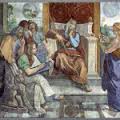
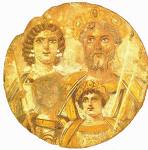 In the Old Testament, the term "house" figuratively references one's family unit. A family unit, includes not only an immediate nuclear family but usually a somewhat extended family and those who are dependent on and connected to that family in some way, all under the householder's authority. Thus, when Joshua promises that "I and my house will serve the Lord," he means his family and other people living with his family under his authority would serve the Lord. Similarly, in Genesis, as Acts 7.10 recounts, when Joseph becomes governor over Egypt and Pharaoh's household, he has stewardship both of the nation and the Pharaoh's family and attendants. "He gave Joseph wisdom and enabled him to gain the goodwill of Pharaoh king of Egypt. So Pharaoh made him ruler over Egypt and all his palace." ✞
"Acts Christian Home"
by Ron Meacock © 2021
| ^Top Page | Next | Previous |