Brothers :
The Holy Spirit
and Jesus
| Next | Previous | Index | Tellout Home |
18. Holy Spirit's Creation
Outgoing Creative Energy
 We see the Holy Spirit "hovering" over the newly formed Creation at the world's origin. We read in Genesis 1.2, "Now the earth was formless and empty, darkness was over the surface of the deep, and the Spirit of God was hovering over the waters." Frank Derek Kidner (1913-2008) was a British Old Testament scholar best known for writing commentaries. He summarizes the work of the Holy Spirit on creation in Genesis this way, "In the Old Testament, the Holy Spirit is a term for God's outgoing, creative energy and sustaining."✞
Creation Jesus
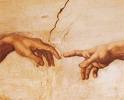 God's Son, Jesus, also presents with the Holy Spirit and the Heavenly Father at the initial formation of all matter. This point in time is commonly known as "the big bang," though there is a new scientific theory that it is more of a gathering of bits of created material into moons, planets, and galaxies. Scientists postulate that the big bang all took place in a fraction of a second though I find it hard to perceive moons, planets, and suns being flung across the universe almost instantaneously. It defies logic, but there again, God is not bound by logic nor the physical laws we have discovered and that synchronize our clocks and our minds. Genesis 1.1 explains the creation as six "days of creation." We should note here that the word for "Days" also means "eons." An "Eon" is, in geological terms, "a major division of geological time, subdivided into eras." Saint Paul writes in Colossians 1.15-16, "The Son is the image of the invisible God, the firstborn over all creation. For in him all things were created in heaven and on earth, visible and invisible, whether thrones, powers, rulers or authorities. All things have been created through him and for him." Jesus has a vital role in the Creation itself. ✞
Creator Spirit
 The Genesis narratives describe the enormous possible power of the creator Spirit and Jesus. They appear together at the origins of all matter in the universe. The presence of Jesus at the Creation and his partnership with the creative Spirit are events of the highest possible magnitude in human history. It is no accident that Jesus Christ divides history into "Anno Domini" (AD), meaning "in the year of the Lord" and refers specifically to the birth of Jesus Christ. "BC" indicates "before Christ." These terms indicate or label years in the Julian and Gregorian calendars from 525 AD counting the years from Jesus's birth. ✞
The Ethiopian Calendar
A fascinating alternative is the Ethiopian calendar seven years and eight months behind the Western calendar, which calculates the 11th September 2021 as the start of 2014, and the 12th September on leap years. Every month has 30 days except the last of the year, which has five or six days. Each day is divided into twelve-hour periods starting at 6 am, making both midday and midnight at six o'clock in Ethiopian time. When the Western church altered its calculation of the birth year of Jesus Christ, the Ethiopian Orthodox Church did not. In the words of Charles Malik of Lebanon (1906-1987), an academic, diplomat, and philosopher, "Jesus Christ is the hinge of history, the origin of Christianity." Saint John explains the coming of Jesus in 1 John 1.1. "From the beginning, what we have heard, seen with our eyes, looked at and our hands have touched - this we proclaim concerning the Word of life." Note that John describes Jesus as "from the beginning," which connects to Genesis 1.1 "In the beginning, God." ✞
Holy Jesus
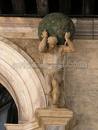 Bruce Larson (1925-2008), who ministered at the Crystal Cathedral in California in his book "Believe and Belong," describes two statues on Fifth Avenue in New York. He views them as an illustration of the Holy Spirit's work with Jesus in the Creation. At the RCA Building entrance, now renamed the "GE Building," stands a muscular Atlas straining to hold up the world on his shoulders. On the opposite side of Fifth Avenue in St Patrick's Cathedral is a statue of the little boy Jesus, at perhaps 8 or 9 years old, who, with no effort, is holding the world in one hand. The second person of the Trinity, Jesus, is more than our Savior, for he holds up the earth in his hand by his word and power. ✞
Dust of the Ground
 The life-giving Spirit breathed the Creation breath into the World and the Universe. He brought it into being from nothing and gave it ongoing life! At the beginning, the life-giving Spirit filled a human created by God. In Job 33.4, we read, "The Spirit of God has made me; the breath of the Almighty gives me life." God's hand created a human being from dust in Genesis 2.7 but it was lifeless until the Almighty breathed into it. "Then the Lord God formed a man from the dust of the ground and breathed into his nostrils the breath of life, and the man became a living being." Interestingly, modern scientists have discovered that every chemical element in the human body is present in the dust of the ground. We note here that the Hebrew for "man" is "Adam," and this sounds like and may be related to the Hebrew for "ground," which is "adamah." It is also the name of the first human being appropriately named "Adam." ✞
Life-Giving Spirit
New Testament translators used the word "spirit" to represent the Greek noun "pneuma," which means "a current of air." It is familiar to us in such modern phrases as "pneumatic tires," which means "containing or operated by air or gas under pressure." This life-giving "breath, wind or spirit" is a translation of the Hebrew word "ruach," which itself sounds like a deep breath from the lungs. The Holy Spirit appears in the Old Testament as God's energy let loose. The author W. McNeile Dixon (1866-1946) writes in "The Human Situation" that "It is not the lofty sails but the unseen wind that moves the ship." As time passes, the word "Spirit" begins to symbolize other forms of unseen energy or life. ✞
Holy Spirit's Fingers
 One undeniable universal principle for all who believe is that "when God takes away his breath, everything dies and returns to dust." The direct opposite of this, of course, is the bringing of life by the Spirit. The Psalmist writes in Psalm 104.30, "When you send your Spirit, they are created, and you renew the face of the ground." The Holy Spirit or "Spirit of God" refers to "the divine force, quality, and influence of the Highest God." It also refers to the person of the Holy Spirit in the Trinity. Scholars explain that the phrase "Holy Spirit" literally means "the Spirit of the holiness" or "the spirit of the holy place." The Christian understanding of "The Holy Spirit" differs from the Jewish one in that Jewish scholars believe that the term "Spirit" refers to the "divine characteristic of prophecy and wisdom." ✞
The Spirit's Role
In contrast, Christians regard the Holy Spirit as a "separate identifiable person in the Godhead." One of the Spirit's roles is to bring new life and renewal to people, plants, animals, and all living things on the earth. In the debate around the theories of "evolution" where "genetic changes and natural selection account for the variety of humankind" and "creation" or the "instantaneous forming from nothing of all matter, beings, plants, and animals," we have forgotten that God entirely and utterly finished the Creation. God himself describes it as being "very good." After that, the Holy Spirit sets about sustaining and undoubtedly adapting it to an ever-changing environment. This adaption is an anticipated work of the Holy Spirit, perfectly normal and to be expected. ✞
Beautifying and Adorning
The Holy Spirit has the unique job of beautifying and adorning the heavens after the original Creation. According to Job 26.13, "By his breath the skies became fair; his hand pierced the gliding serpent." Psalm 8.3 extends this thought, "When I consider the heavens, the work of your fingers, the moon, and the stars, which you have set in place, what is mankind that you are mindful of them, human beings that you care for them?" This last phrase may equally mean, "what is a human being that you are mindful of him, a son of man that you care for him?" Human beings are a mere drop in the bucket when compared to the moon and the stars and the rest of God's creation, but cares particularly for every one of us, and that includes you and me! ✞
The Finger of God
The phrase "your fingers" appears in Psalm 8.3. "When I consider Your heavens, the work of your fingers" refers to the Holy Spirit's work at the Creation. John Owen (1616-1683), the devout Welsh Nonconformist Puritan leader, writes, "By the finger or fingers of God, the Spirit of God is in a special manner intended." Owen married Mary Rooke and had eleven children. Tragically, ten of them died in infancy, but Owen was unfailing in his faith. He was a convinced Calvinist and argued for the predetermined will of God, who directed all things. Loss of all his children, even the eleventh of consumption, did not deter him but reinforced his faith in the Almighty's all-encompassing will. He was a man firm in his belief in the Holy Spirit's fingers, working in all aspects of his life to the end! ✞
"Holy Spirit's Creation"
© 2021
by Ron Meacock
| Top Page | Next | Previous |