
Brothers :
The Holy Spirit
and Jesus
| Next | Previous | Index | Tellout Home |
9. Samaritan Woman
Jesus Forgives People
The Early Church identified the Samaritan woman at the well as "Photini," or later, "Saint Photini" or "Photine." In his conversation with her, Jesus did a remarkable thing considering she was a Samaritan woman and considering the customs and religious prohibitions of the time. The Jewish institution intensely despised Samaritans and regarded them as "half-castes" and heretics to the Jewish Faith. The law prohibited Jewish men from talking to women when alone. Jesus was a Jewish man, and yet he spoke to her. Rather than despising her in his questions and answers, he empathizes and gently points her to the truth. Jesus, both here and on other occasions, shows a warm and forgiving spirit to everyone he meets. The woman ends up telling all and sundry how marvelous Jesus is! In John 4.29-30, she announces, "Come, see a man who told me everything I ever did. Could this be the Messiah?" As a result, people come out of the town and make their way towards him. Jesus forgives other people, but he not only forgives this woman, but he also empowers her!✞
Paralytic Lowered
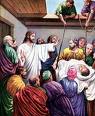 On another occasion, in Luke 5.18-20, we read, "Some men came carrying a paralyzed man on a mat and tried to take him into the house to lay him before Jesus. When they could not find a way to do this, they went up on the roof, knocked a hole in it, and lowered his mat into the middle of the crowd in front of Jesus. When Jesus saw their faith, he said, 'Friend, I forgive your sins.'" The law teachers watched and became critical because he said that he forgave the young man's sins. The Law teachers believed that only God could forgive sin and, although they were right, they didn't realize that he was also God. Jesus forgave people, even though they may not have believed that he was God himself in human form. Some of the law teachers said to themselves, as recorded in Luke 5.21, "Who is this fellow who speaks blasphemy? Who can forgive sins but God alone?"✞
Jesus Freedom Walk
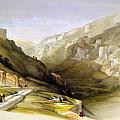 When we experience Jesus' freedom walk, we know the forgiveness of sins and the power to dismiss evil thoughts and become truly free. After Jesus healed the paralyzed man lowered on his bed, the teachers of the law criticized him. Knowing their thoughts, Jesus said to the teachers of the law in Matthew 9.4-6, "Why do you entertain evil thoughts in your hearts? Which is easier: to say, 'I forgive your sins,' or to say, 'Get up and walk?' But I want you to know that the Son of Man has authority on earth to forgive sins.' So he said to the paralyzed man, 'Get up, take your mat and go home.'" Jesus knew their thoughts revealed by the Holy Spirit, and being released from his sins, the man did the Jesus freedom walk! A physical action resulted from a spiritual transformation. Jesus asserts that because of his deity, he has the authority to forgive sins and release people from the hold that sin has on us, including illness. The grateful man, who was no doubt thoroughly confused by the law teachers now, did the Jesus freedom walk. He walked off to show himself to his family!✞
Jesus Healing Power
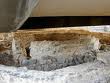 Jesus' healing power comes to Peter's mother-in-law in Capernaum on the Sea of Galilee shores. The New Testament is full of examples. Matthew 4.24 reads, "News about him spread all over Syria, and people brought to him all who were ill with various diseases, those suffering severe pain, the demon-possessed, those having seizures, and the paralyzed; and he healed them." There seems to have been nothing that Jesus could not cure. One particular instance occurred at the home of Peter in the town of Capernaum at the Northern end of the Sea of Galilee. We read of this miracle in Luke 4.38-39, "Jesus left the synagogue and went to the home of Peter. Now Peter's mother-in-law was suffering from a high fever, and they asked Jesus to help her. So he bent over her and rebuked the fever, and it left her. She got up at once and began to wait on them." Jesus' healing power and lordship extended still further. As God, his healing power can completely heal individuals, not in a slow transition but instantly.✞
Peter's Mother-in-Law
 The house which belonged to Peter's mother-in-law, where this miracle took place, still stands today, on the shores of the Sea of Galilee in the village of Capernaum. The church extended it early to accommodate travelers and pilgrims, later building over it with a large church on a concrete structure. On this occasion, Jesus' healing power pours forth on Peter's mother-in-law. He has just left the synagogue, which is among the oldest in the world, and the remains of which still stand just a short walk up the road from Peter's mother-in-law's house. Interestingly, several Christian symbols like an anchor and a fish appear on grave markers in this ancient cemetery from the earliest times. These engravings were early Christian symbols.✞
Jesus Healing
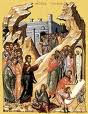 Jesus' healing power and the Good News were made available to all who came to him, whether rich or poor or who they were. Jesus became known in the whole area not only because he preached the Good News but by showing his healing power over people with physical and mental problems of all kinds who flocked to him. Luke 4.40 told us, "At sunset, the people brought to Jesus all who had various kinds of sickness, and laying his hands on each one; he healed them. Moreover, demons came out of many people, shouting, 'You are the Son of God!' But he rebuked them and would not allow them to speak because they knew he was the Messiah." Here, we saw Jesus' healing power over sickness, physical disabilities, mental illnesses, and possession by demons. He did not allow the demons to speak because they knew he was the "Christ," otherwise called "the Chosen Messiah" or "the Anointed One" from God.✞
Exhausted Jesus
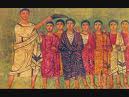 Jesus' healing work took such a toll on him that he became exhausted and tried to find some quiet on his own. He clarifies that his mission is not to become a traveling healer alone but primarily a Good News preacher. Luke 4.42-44 tells us, "At daybreak, Jesus went out to a solitary place. The people were looking for him, and when they came to where he was, they tried to keep him from leaving them. But he said, 'I must proclaim the good news of the kingdom of God to the other towns also because that is why God sent me.' And he kept on preaching in the synagogues of Judea." At some point, all committed Christians and especially preachers and Christian leaders, need to retreat like Jesus to a solitary place to recharge their spiritual batteries for the vital work of preaching the Good News.✞
"Samaritan Woman"
by Ron Meacock © 2021
| Top Page | Next | Previous |