
| Next | Previous | Index | Tellout Home |
61. Roman Christians' Persecution
Revelation 17.6-8
"I saw that the woman was drunk with the blood of God's holy people, who bore testimony to Jesus. When I saw her, I was greatly astonished. Then the angel said to me: 'Why are you astonished? I will explain to you the mystery of the woman and the beast she rides, which has the seven heads and ten horns.' The beast, which you saw, once was, now is not and will come up out of the Abyss and go to his destruction. The earth's inhabitants not written in the book of life from the world's creation will be astonished when they see the beast because he once was, now is not, and yet will come." (Revelation 17.6-7) ✞
Ancient Rome
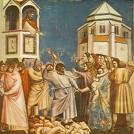 How John of Patmos describes Roman Christian persecution is very significant. He says that ancient Rome was "drunk with God's holy people's blood." He implied persecution of the saints and martyrs was a legal necessity because Christians would not partake in Emperor worship. The authorities took great delight in persecuting and hounding Christians even to death. The Empire's oppression stamped Ancient Rome as the great persecutor. She reveled in slaughter and enjoyed it as a drunken person relishes wine. ✞
Who Burned Rome?
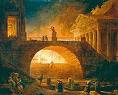 No doubt, John of Patmos thought of the Empire-wide persecution under Emperor Nero (27-68 AD). The Neronic persecution sprung from the great fire of Rome in 64 AD, which burned for six days and devastated the city, according to Tacitus (54-117 AD), a senator, historian, and observer. There was a myth that "Nero fiddled while Rome burned," but this cannot be true because "fiddles or violin-like instruments did not exist until the 11th century AD," according to the Daily Express writer William Hartston (1947-present)! Rome's people believed that the fire was no accident, and they also witnessed those who tried to extinguish it hindered. When it did die down, the emperor's supporters deliberately rekindled it! People in Nero's reign believed that the fire's instigator was none other than Emperor Nero himself. Nero had a passion for impressive buildings. The people thought he deliberately burned down part of Rome's old, dilapidated wooden city to rebuild it with grandiose marble public buildings. After the fire, Nero built a large landscaped portico villa called the "Domus Aurea" or "Golden House" in ancient Rome's heart. The Roman Christian persecution began when Emperor Nero falsely accuses them of setting fire to Rome. Emperor Nero had to find a scapegoat to divert suspicion from himself, so he focused on Christians. The persecution was the earliest great oppression and the most savage of all. ✞
Emperor Nero
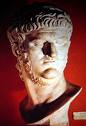 Nero was a brutal individual. When he was only 16 or 17 years old, he had his mother killed, and later in 62 AD also ordered his wife, Claudia Octavia (39-62 AD) murdered. He was also a little mad. William Hartston comments, "In 67 AD, Nero competed in the then Olympic Games and remarkably won events in chariot racing, singing, and acting, probably by bribing the judges." ✞
The Name Christian
 According to the Roman historian Tacitus (54-117 AD), Emperor Nero made a scapegoat of Jesus Christ's followers. Tacitus wrote in his "Annals 15.44," "Christus, from whom the name Christian had its origin, suffered the extreme penalty during the reign of Emperor Tiberius, (BC 42-37 AD) at the hands of one of our procurators, Pontius Pilatus, (12 BC -?) (Prefect of the Province of Judea 26-36 AD). A most mischievous superstition, thus checked for the moment, again broke out not only in Judaea, the first source of the evil but even in Rome, where all things hideous and shameful from every part of the world find their center and become popular." Tacitus then spoke of the Roman Christian persecution by Nero, "Accordingly, all who pleaded guilty were arrested, then, upon their information, an immense multitude was convicted, not so much of the crime of firing the city, as of hatred of humankind. They added to their deaths mockery of every sort. They were covered with beasts' skins, torn by dogs, perished, or nailed to crosses. They were doomed to the flames and burned to serve as a nightly illumination when daylight had expired." Tacitus's description of Rome's persecution of Christians is one of the few passages in pagan literature where Christ's name independently occurs and describes the early Christians' terrible abuse and suffering. ✞
Emperor Decius
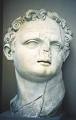 In 250 AD, the Decius Christian persecution occurred under the Roman Emperor Decius (201-251 AD). He issued a proclamation ordering the Empire's citizens except the exempted Jewish people sacrifice to the Roman gods and the emperor's well-being. The certificate had to be completed in a Roman magistrate's presence, signed and witnessed with a magistrate's certificate called a "libellus." Although the proclamation's text is lost, many certificates survive signed by the magistrate and witnesses from Egypt.
"To the commission chosen to superintend the sacrifices. From Aurelia Ammonous, daughter of Mystus, the Moeris quarter, priestess of the deity Petesouchos, the great, the mighty, the immortal. I have sacrificed to the gods all my life. Now again, following the decree and in your presence, I have made a sacrifice. I have poured out a libation and partaken of the sacred victims. I request you to certify this below."
Decius reported that suspected Christians who cursed Christ were freed, showing that persecuting Christians was not Decius' mandate or goal. Nothing in these "libelli" inferred any need to deny being a Christian, unlike the provincial governor Pliny the Younger's (61-113 AD) letter written to Emperor Trajan (53-117 AD) in 112 AD. ✞
Empire-wide Loyalty Oath
 Decius intended his proclamation as an Empire-wide loyalty oath at his coming to power in 249 AD. He did not seek to target Christians specifically or persecute followers. However, because the Romans did not consider Christianity a religion, they were not exempt. So they were forced to choose between their religious beliefs and following the law. Their faith in one God did not allow them to worship other gods. In the event, many Christians were executed or imprisoned for refusing to perform sacrifices. Others hid, while some performed the ceremonies regardless. The effects were long-lasting in that it caused tensions between Christians who agreed to the worship or fled and those who did not. ✞
"Roman Christians' Persecution"
by Ron Meacock © 2021
| ^Top Page | Next | Previous |