
| Next | Previous | Index | Tellout Home |
32. Temple Court Throne
Revelation 7.15-17
"Therefore, they are before God's throne and serve him day and night in his temple. He who sits on the throne will spread his tent over them. Never again will they hunger, nor thirst. The sun will not beat upon them, nor any scorching heat. The Lamb at the throne's center will be their shepherd. He will lead them to living water springs. And God will wipe away every tear from their eyes." (Revelation 7.15-17) ✞
Seeing God
 People from every race, tribe, and tongue are before the temple court throne in this vision. Those faithful and pure in heart will enter into God's very presence and serve him day and night. Jesus says in Matthew 5.8, "Blessed are the pure in heart, for they shall see God." Here is an astonishing revolution. In Jerusalem's earthly temple court, no non-Jew could go beyond the Gentiles' Court on the threat of death. But here, every Christian stands before and near God, no matter what race or people they may be. I remember standing in the rose garden at Westminster Abbey in London for the Church Army centenary celebration. I was about six feet from the Queen. I took her photo and then realized how special that moment was, being so close to a reigning monarch, one of the wealthiest people on earth with extraordinary influence at her fingertips. ✞
Being With God
But here is a more extraordinary situation in heaven where Christians stand alongside God! Then, another revelation that maybe Her Majesty and I will stand together before God! The vast majority of even devout Jewish people could never do this. A Jewish person could cross the Women's Court but not enter the Holy of Holies. The Holy of Holies was reserved for the High Priest to enter alone once a year. But in the heavenly temple, the way to God is now open to faithful people from anywhere. Heaven has an open temple court with no barriers. Distinctions of race and status exist no more for the faithful believer, the pure in heart, who can enter into Almighty God's presence. ✞
Lord's Glory Tent
 There is more to the words, "he who sits upon the throne will spread his tent over them," than meets the eye. The Greek translation for "dwell" is "skenoun," from "skene," meaning "a tent," which is the Lord's tent or tabernacle. Over the throne will be spread the Lord's glory tent like a canopy shading his saints from hunger, thirst, and scorching heat. ✞
Dwelling With Us
The Hebrew translated this word "tent" as a "residence" or "dwelling place" and surprisingly it is the same word used in John 1.14 "The Word became flesh and made his dwelling among us." John of Patmos says that God becomes a human being and "dwells" or "resides" amongst us. Christians can know God's actual presence in Jesus' person dwelling within us! Many Jewish people connected "skene," meaning "tent," with another Hebrew word, "shechinah," or "dwelling." This word is sometimes written as "shekinar," indicating the actual visible presence of God's glory. Here it means the "Lord's glory tent." ✞
Lord's Tabernacle Glory
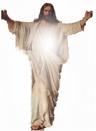 When the Lord gave the Ten Commandments on Mount Sinai in Exodus 24.16-17, we read, "the Lord's glory settled on Mount Sinai. For six days, the cloud covered the mountain, and on the seventh day, the Lord called Moses from the cloud. To the Israelites, the Lord's glory looked like a consuming fire on a mountain top." Mount Sinai means "Moses' mountain" and is also known as "Mount Horeb" or "Jebel Musa" in the Egyptian Sinai Peninsula. Sinai is a moderate 7,497 feet high peak surrounded by higher mountains in the same range. The Lord's tabernacle glory covered the people and went before them like a nightly fire and a daily cloud. ✞
Filled With the Lord's Glory
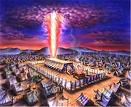
Never again would the Lord's people hunger or thirst for the temple is where God's presence dwells. The cloud over the tabernacle covers the people, and they serve him day and night under his protection. Even Moses could not enter the Old Testament's tabernacle because the Lord's glory filled it. In Exodus 40.34-38, we read, "Then the cloud covered the meeting tent, and the Lord's glory filled the tabernacle." The people led by Moses would set out whenever the cloud lifted from above it, but they would not move if the cloud did not rise. The cloud hovered over the tabernacle by day, and the fire by night, in the sight of all. At Solomon's temple dedication in 2 Chronicles 7.1b, we read, "the Lord's glory filled the temple." Even the priests could not enter the temple because the Lord's glory was there! ✞
Filled the Temple
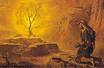 To say that God has a dwelling place is to say that his glory is there. The Hebrew verb translating "filled" in "the Lord filled the Temple" is in the present continuous tense, which means it reflects an "ongoing, dynamic situation." Many Jew people came to think of God as remote from the world. They did not even consider it right to speak of God in human terms, and so they took to calling God by the name "Shechinah" or "glory" instead. ✞
Lord's Glory
 In Revelation, the Lord's Shekinah glory is found in the temple and centers on Jesus' person amongst God's blessed ones. In Genesis 28.16b, we read Jacob's words at Bethel, "Surely the Lord is in this place, and I was not aware of it." In their wisdom, reverence, and fear of speaking God's holy name, the Rabbis changed the word "Lord" to "Lord shekinah." Habakkuk 2.20 reads, "The Lord is in his holy temple." ✞
Shekinah glory
Later, Jewish rabbis changed this verse to read, "God was pleased to cause his "Lord's shekinah" to dwell in the temple." Isaiah 6.5 also reads, "'Woe to me!' I cried." "For I am a man of unclean lips, and I live among a people of unclean lips, and my eyes have seen the King, the Lord Almighty.'" Jewish scholars later revised this verse to read, "My eyes have seen the Lord's Shekinah glory of the king of the world." Ordinary Jewish people and Rabbis were not setting out to change the Scriptures but, out of reverence, avoid saying God's holy name, whether "the Lord" or "the King Almighty." Instead, they used the titles "the Lord's Shekinah" or the "Lord's glory." ✞
God Spreads his Tent
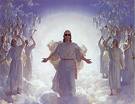 The idea that God would "shelter them with his presence" meant that he would "spread his tent over them." God's blessed ones live and serve in God's very presence and glory, "the Lord's Shekinah." Those who faithfully work on earth for the Lord Jesus have the Lord's Shekinah glory on them and their ministry. ✞
Living Water Springs
 The Lamb Jesus became a temple shepherd to lead his thirsty people from the scorching heat to the living water spring. "Hunger and thirst" were common factors in Jesus' time, and there was often no food or drinking water available. At times, the wells ran dry, and the unrelenting heat scorched the empty river beds. Isaiah 49.10, prophesying the future, says, "They will neither hunger nor thirst nor will the desert heat or the sun beat down on them. He who has compassion on them will guide them and lead them besides water springs." No one will suffer these everyday stresses in heaven, for there will be no "scorching heat" from the searing sun. Here, there is shade, peace, and living water springs. ✞
Lamb Becomes Shepherd
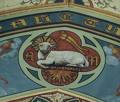 The Lamb now becomes a shepherd, a curious transformation, to lead the chosen people to living water, God's very presence. When you are suffering physically or emotionally, take comfort that God will give you his "living water." The water of life which Jesus brings is a body and soul's refreshment. God will protect his people. Isaiah 25.10 reads, "He will swallow up death forever. The Sovereign Lord will wipe away tears from all faces. He will remove his people's disgrace from all the earth. The Lord has spoken." As in the wilderness, where the wood and animal skin moveable structure called the tabernacle enclosed God's presence, so here God spreads out a tent over the chosen ones. Instead of standing outside, the people come into the Holy of Holies. No harm can come to those under Almighty God's shade. ✞
Temple Court Throne"
by Ron Meacock © 2021
| ^Top Page | Next | Previous |