| Next | Previous | Index | Tellout Home |
24. Jesus Slain Lamb
Revelation 5.6-8
"Then I saw a Lamb, looking as if it had been slain, standing in the throne's center, encircled by the four living creatures and the elders. He had seven horns, and seven eyes, which are the seven spirits of God sent out into all the earth. He went and took the scroll from the right hand of the one who sat on the throne. And when he had taken it, the four living creatures and the twenty-four elders fell before the Lamb. Each one had a harp, and they were holding golden bowls full of incense, which are the saints' prayers." (Revelation 5.6-8) ✞
Jesus the Lamb
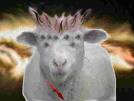 The "seven spirits of God" may be translated as "the sevenfold Spirit," meaning the Holy Spirit. An elder called to John of Patmos to look at the "Lion," but John saw "a Lamb" when he turned around. "The Lamb" is the main title for Jesus Christ and is used twenty-nine times in Revelation. It is employed only once elsewhere in the New Testament in John 21.15, where Jesus says to Peter, "Feed my lambs." ✞
Supreme Knowledge
"The Lamb" is pictured with seven horns indicating his absolute power and seven eyes revealing his supreme knowledge. We find it difficult to visualize such a creature, but this describes Jesus. Jesus' appearance to receive God's scroll "as a Lamb" was like a king's coronation. The four living creatures encircled the throne, and the twenty-four elders surrounded Jesus as the focal point. The "Lamb" stands in the center of the whole heavenly scene. ✞
Lamb's Wounds
 The term "Lamb of God" comes from the Latin "Agnus Dei." It is Jesus' title in John 1.29, "The next day John (the Baptist) saw Jesus coming toward him and said, 'Look, the Lamb of God.'" In Christianity, the Lamb of God concept is central to our beliefs. The Lamb bears the crucifixion's sacrificial wounds, but simultaneously God clothes him with might to annihilate his enemies. ✞
Two Lamb Words
The Greek words for Lamb in Revelation are significant. John of Patmos always uses the term "arnion," meaning "a young Lamb" or "a little lamb" or (figuratively) "a person with pure (innocent), virgin-like (gentle) intentions." In all other Bible passages, the term for "lamb" is "amnos," meaning "a sacrificial lamb or a young sheep without blemish (especially a one-year-old lamb)." John the Baptist points to Jesus as the "amnos," the "Lamb of God." The disciples' fisherman leader, Saint Peter, wrote of Christ in 1 Peter 1.18-19. "For you know that it was" "with Christ's precious blood, a lamb ("amnos") without blemish or defect." ✞
Gentle Lamb
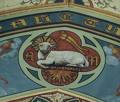 The prophet Jeremiah also employed the word "amnos" when he how the people were plotting against him in Jeremiah 11.19, "the Lord revealed their plot to me" "I was like a gentle lamb led to the slaughter." Isaiah 53.7 spoke of "the lamb (amnos) brought to the slaughter," which was a reference in its context to Jesus' crucifixion. In Revelation, by using "arnion" instead of "amnos" and using it so often, John wishes us to see that the Jesus' slain Lamb concept is a brand new one and not a repeat of an Old Testament idea. ✞
Crucifixion Wounds
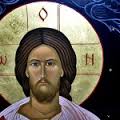 John of Patmos sees the Lamb as if it had been "slain." The wounds inflicted on Jesus' body during his trial and crucifixion are still visible, asserting that Jesus is the final sacrifice for all sins. Although Christ is a sacrificial lamb, he is not weak. He died, but now he lives in God's strength and power. Even in heaven, Jesus Christ is the one who loves us and gives himself for us. With the crucifixion marks always on him, Jesus is the powerful and all-knowing Lamb. He will erase all other wounds and blemishes on Christians in our new bodies, but not for Jesus. He retains the crucifixion marks on his hands, feet, head, and side for eternity. His wounds make us aware the Lamb still exhibits his crucifixion in heaven. ✞
Seven Horns
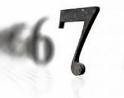 The Lamb's seven horns and seven eyes use the symbolic number seven, indicating completeness. The seven horns show the Lamb's supreme power and the seven eyes that he sees everything. This passage suggests that the seven horns and seven eyes are as significant as God's seven spirits sent out upon the earth. The horn takes on different meanings in different contexts. "Horns" stand for "sheer power" or "honor." In the Old Testament, the prophet Zechariah is described in 1 Kings 22.11, "Now Zedekiah son of Kenaanah had made iron horns, and he declared, 'This is what the Lord says, "With these, you will gore the Arameans until destroyed."'" Such was the horns' immense symbolic power. None can withstand his all-conquering might or escape his all-seeing eye. ✞
Powerful Horns
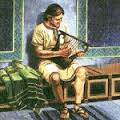 Zedekiah's iron horns were a sign of God's unconquerable strength. The "Lamb of God's seven horns" also indicates "honor" and "strength." Psalm 89.17 reads, "For you are their glory and strength, and by your favor, you exalt our horn." "Our horn" symbolizes "strength." In Psalm 112.9, he also writes, "God will lift high their horn in honor." The "horn" here indicates another quality, "dignity." Psalm 148.14 adds, "And he has raised for his people a horn, the praise of all his faithful servants." Here, the "horn" points to "strength in praise." God increases the honor, dignity, and strength of those who trust him. The "seven horns" emphasize the Lamb's perfection, for his power is complete and irresistible. ✞
Seven Eyes
 The Lamb's seven eyes are the "seven spirits of God sent out into all the earth." The picture comes from Zechariah 4.10, where the prophet sees the seven lamps, "the eyes of the Lord, which range through the whole earth." It is an eerie but clear picture of God's omniscience or all-knowing nature. There is no place on earth that is not under God's surveyance. The Lamb's seven eyes view everything and survey all as he stands in the center of God's throne encircled by the four living creatures and the elders. ✞
Majesty and Meekness
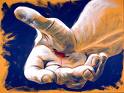 The Lamb is the fulfillment of all Israel's hopes and dreams. A temple worshipper intended "a lamb without blemish" for sacrifice, but now the "Lamb of God" becomes that offering. He is the culmination of centuries of Temple and Tabernacle offerings on earth. God provides forgiveness for human beings' sins at one historical point for those who trust him. God turned the tragedy into triumph, and shame became glory. According to the Biblical Commentator Henry Barclay Swete (1835-1917), "in the Lamb of God, we see Jesus Christ's majesty and meekness." In him are his deathly humiliation and risen glory. ✞
"Jesus Slain Lamb"
by Ron Meacock © 2021
| ^Top Page | Next | Previous |