| Next | Previous | Index | Tellout Home |
11. Roman Emperor Augustus
Revelation 2.12-16
"To the Pergamum church angel write: 'These are the words of him who has the sharp, double-edged sword. I know where you live, where Satan has his throne.' Yet, you remain true to my name. You did not renounce your faith in me, not even in Antipas' days, my faithful witness put to death in your city where Satan lives. Nevertheless, I have a few things against you: There are some among you who hold to Balaam's teaching, who taught Balak to entice the Israelites to sin so that they ate food sacrificed to idols and committed sexual immorality. Likewise, you also have those who hold to the Nicolaitans' teaching. Repent therefore! Otherwise, I will soon come to you and will fight against them with the sword of my mouth." (Revelation 2.12-16) ✞
Emperor Augustus
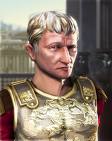 Emperor Augustus (BC 63-14 AD) was the first and known as Rome's Greatest Emperor. He was born in Rome as Gaius Octavius. In BC 43, Julius Caesar's assassination took place, and Augustus was named his successor. The Roman Senate conferred on him the name Augustus meaning "the Exalted One." He replaced the Roman republic with a monarchy and brought stability and peace during his long reign. He avenged Caesar's death by defeating Antony and Cleopatra at the Battle of Actium in BC 31. He is probably remembered most for giving us August's name. In 8 B.C. Augustus had the Roman month of Sextilius renamed after himself, as his great-uncle and predecessor Julius Caesar had done with July. He also named his homeland "Italy." ✞
Caesar's Oath
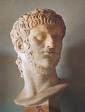 Early Roman emperors like Emperor Augustus refused to be worshipped or be called gods by their people. Later, however, other Emperors realized that this could be politically useful. Some started believing they were gods and expected to be treated as such by their people. Citizens were required to burn a pinch of incense to the emperor's bust in the public square and say, "Caesar is Lord" as a loyalty test, which became a unifying principle in the Roman Empire. It was also a simple and easy way to separate those disloyal to the emperor and pinpoint Christians. Christians believed that "Jesus is Lord" and to burn incense to any other God, not least a pagan idol, even the emperor's image, was wrong. In those days, "pagan" described anyone who was not a Christian and worshipped any other god or none. The earliest statement of faith was, "Jesus is Lord." 1 Corinthians 12.3 reads, "Therefore I want you to know that no one speaking by God's Spirit says, 'curse Jesus,' and no one can say, 'Jesus is Lord,' except by the Holy Spirit." "Jesus is Lord" became a counter to the emperor's oath of allegiance of "Caesar is Lord." This loyalty oath is a backdrop to the Book of Revelation. ✞
Pergamum's Satan's Throne
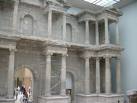 In Pergamum, also written as "Pergamon," they set up the emperor's bust in the town square. This condemnation place for Christians became where "Satan has his throne." The "Pergamum Satan's Throne" was the official emperor worship center in Asia, with temples to Roman Emperor Augustus (BC 63-14 AD) and Trajan (53-117 AD). In one sense, Rome was Satan's capital, and "Pergamum" was Satan's throne. The Satanic Zeus Temple was dedicated to the Roman deity Zeus in Pergamum City and looked like a giant throne on top of an eight hundred-foot high clifftop. The Zeus temple was on an impressive forty-foot-high projecting ledge of rock where Emperor Caesar Augustus worshiped Zeus, the pagan sky, and thunder deity. The Christian community hated and feared this place which was always smoking with animal sacrifices. ✞
White Marble Altar
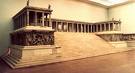 "Where Satan has his throne" may be a reference to the white marble altar in "Pergamum City" dedicated by Eumenes II (BC 221-159). Eumenes II, surnamed "soter" or "savior," was the ruler of Pergamum. This imposing marble altar was dismantled and moved between 1880 and 1896 by the German engineer Carl Humann (1839-1896) to the Pergamum Museum in Berlin, where it is today. The museum has several original full-sized monumental buildings transported from present-day Turkey and meticulously reconstructed stone by stone. It is an imposing edifice and would have been very striking overlooking the city. ✞
Martyr Antipas
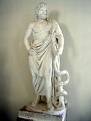
Pergamum and the "Asclepion" religion were connected. It was a pagan temple with a medical healing center. "An Asclepion" meant literally "a healing temple." Asclepion became Pergamum's primary worship place, and the so-called serpent god was called "Asclepion, the Savior." The Pergamum letter also speaks of, "Antipas, my faithful witness, who died in your city where Satan lives." Tradition has it that Antipas was ordained as the Bishop of Pergamum during Emperor Nero's reign and martyred in c92 AD. He was roasted to death over a fire in a copper bull-shaped altar because he cast out demons worshiped by the local people. Later, a tradition developed of oil seeping from Saint Antipas' bones called "the saint's manna." The Early Church used this oil to relieve toothache and other ailments! ✞
Medical Emblem
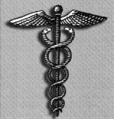
 Interestingly, today, the Asclepion symbol of the serpent wrapped around a staff still appears as the medical profession's emblem, the Rod of Asclepius. The Medical Corps symbol adopted in 1902 in the United States, called "The Caduceus," features two snakes winding around a winged staff. The modern logo may also connect to Moses raising a bronze snake on a pole. When looked upon by sick people with snake bites, God healed them. Numbers 21.8-9 recounts the story, "The Lord said to Moses, 'Make a snake and put it up on a pole; anyone bitten can look at it and live.' So Moses made a bronze snake and placed it on a pole. Then, when a snake bit anyone, if they looked at the bronze snake, they would live." ✞
Pergamum's Library
 The city of Pergamum was built on a steep hill 1,000 feet above the surrounding countryside, creating a natural fortress. It became a sophisticated Greek culture and education center, with a two hundred thousand volume library of parchment scrolls. Scholars constructed the pages in Pergamum Asclepion parchment from animal skins. The writing on smoothed, polished, and sewn-together animal skins into scrolls made them unique. Pergamum was the center of four cults, and it rivaled Ephesus in its idol worship. People traveled from all over the Roman world to receive healing through prayer and worshiping its pagan deity Asclepion. ✞
Deacon Nicolas' Beliefs
 Revelation's Pergamum letter praises Christians for persevering in their faith even in this pagan setting and despite the threat of martyrdom. This letter also admonishes members who advocated immorality and others who followed the Nicolaitans' teaching. According to the Church Fathers Irenaeus (130-202 AD), Hippolytus (170-235 AD), Epiphanes (c310-403 AD), and Theodoret (393-458 AD), the Nicolaitans taught "Deacon Nicolas' heretical beliefs." According to Clement of Alexandria (150-215 AD), Deacon Nicholas' views encouraged licentiousness and sexual immorality. This sect was prominent in Ephesus and Pergamum. Only when they repented would they be received back into the church. ✞
Sword of My mouth
 The Lord will fight against them with the "sword of my mouth," which is possibly a reference to the 24" to 33" long "Roman short sword," called the "gladius" or "Hispanic sword." The word "gladiator" comes from "gladius." The sword was used effectively by Roman soldiers in close battle combat. The armaments of a fully-equipped Roman Legion soldier were a shield (scutum), one or two javelin weapons (pila), a sword (gladius), often a dagger (pugio), and, perhaps in the later empire period, darts (plumbatae). Conventionally, soldiers threw spears to disable the enemy's shields and disrupt enemy formations before engaging in close combat, for which they drew the gladius. A soldier generally led with the shield and thrust with the sword. Gladius' swords appear to have been suitable for cutting and chopping as well as thrusting. This sharp double-edged Roman sword came to represent the "Christian sword of faith." The "gladius" was also the symbol of the Roman proconsul's power. He controlled the justice system and had the life and death of every "accused" person in his hands. ✞
"Roman Emperor Augustus"
by Ron Meacock © 2021
| ^Top Page | Next | Previous |