
| Next | Previous | Index | Tellout Home |
John Mark
Page 92
Jerusalem Residence
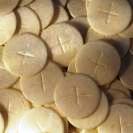 Three great events in the early history of Christianity took place in a Jerusalem home which was possibly John Mark's house in Jerusalem. John Mark who died at the end of the first century AD was named in the Acts of the Apostles as an assistant accompanying Saint Paul and Saint Barnabas on their missionary journeys. He was regarded traditionally as identical with Mark the Evangelist. These special occasions were listed as the "Passover" or the "Lord's Supper" in Mark 14.12-26, "On the first day of the Festival of Unleavened Bread, when it was customary to sacrifice the Passover lamb, Jesus' disciples asked him, 'Where do you want us to go and make preparations for you to eat the Passover?' So he sent two of his disciples, telling them, 'Go into the city, and a man carrying a jar of water will meet you. Follow him. Say to the owner of the house he enters, 'The Teacher asks: Where is my guest room, where I may eat the Passover with my disciples?' He will show you a large room upstairs, furnished and ready. Make preparations for us there.' The disciples left, went into the city and found things just as Jesus had told them. So they prepared the Passover."✞
The appearances of Jesus to the Apostles after his Resurrection also happened in a Jerusalem house in John 20.19-20, "On the evening of that first day of the week, when the disciples were together, with the doors locked for fear of the Jewish leaders, Jesus came and stood among them and said, 'Peace be with you!' After he said this, he showed them his hands and side. The disciples were overjoyed when they saw the Lord."✞
The Holy Spirit also came to the disciples in this Jerusalem house in Acts 2, "When the day of Pentecost came, they were all together in one place. Suddenly a sound like the blowing of a violent wind came from heaven and filled the whole house where they were sitting. They saw what seemed to be tongues of fire that separated and came to rest on each of them. All of them were filled with the Holy Spirit and began to speak in other tongues [or "languages"] as the Spirit enabled them."
John Foster in "The First Advance - Church History 1: AD 29-500" described these events as taking place in John Mark's house in Jerusalem. But "do we know that all three passages refer to the same house?" Mark described the house as having a guestroom in Mark 14.14, "say to the owner of the house he enters, 'The Teacher asks: Where is my guest room, where I may eat the Passover with my disciples?'" It is upstairs in Mark 14.15, and large enough for Jesus and his Apostles. The Apostles in Acts 1.12-13, "returned ... and went up to the upper room where they were staying." It was a very big room because one hundred and twenty people gathered with the Apostles there. Acts 2 began with the Twelve "all together in one place" possibly again in the John Mark house.✞
The Upper Room
No place change is mentioned in John 20.19 and John merely says, "the doors being shut where the disciples were," which seemed to mean "where they were staying." So the three passages probably referred to the same house in Jerusalem. A Jerusalem house where many Christians gathered for prayer was also mentioned in Acts 12. Peter, when he escaped from Herod's prison, knew where he would find his friends. This was "the house of Mary the mother of John, whose other name was Mark." This is the John Mark who later wrote the earliest of the Gospels. This would be the same John Mark house in Jerusalem✞
"John Mark"
by Ron Meacock © 2019
| ^Top Page | Next | Previous |